The Softness
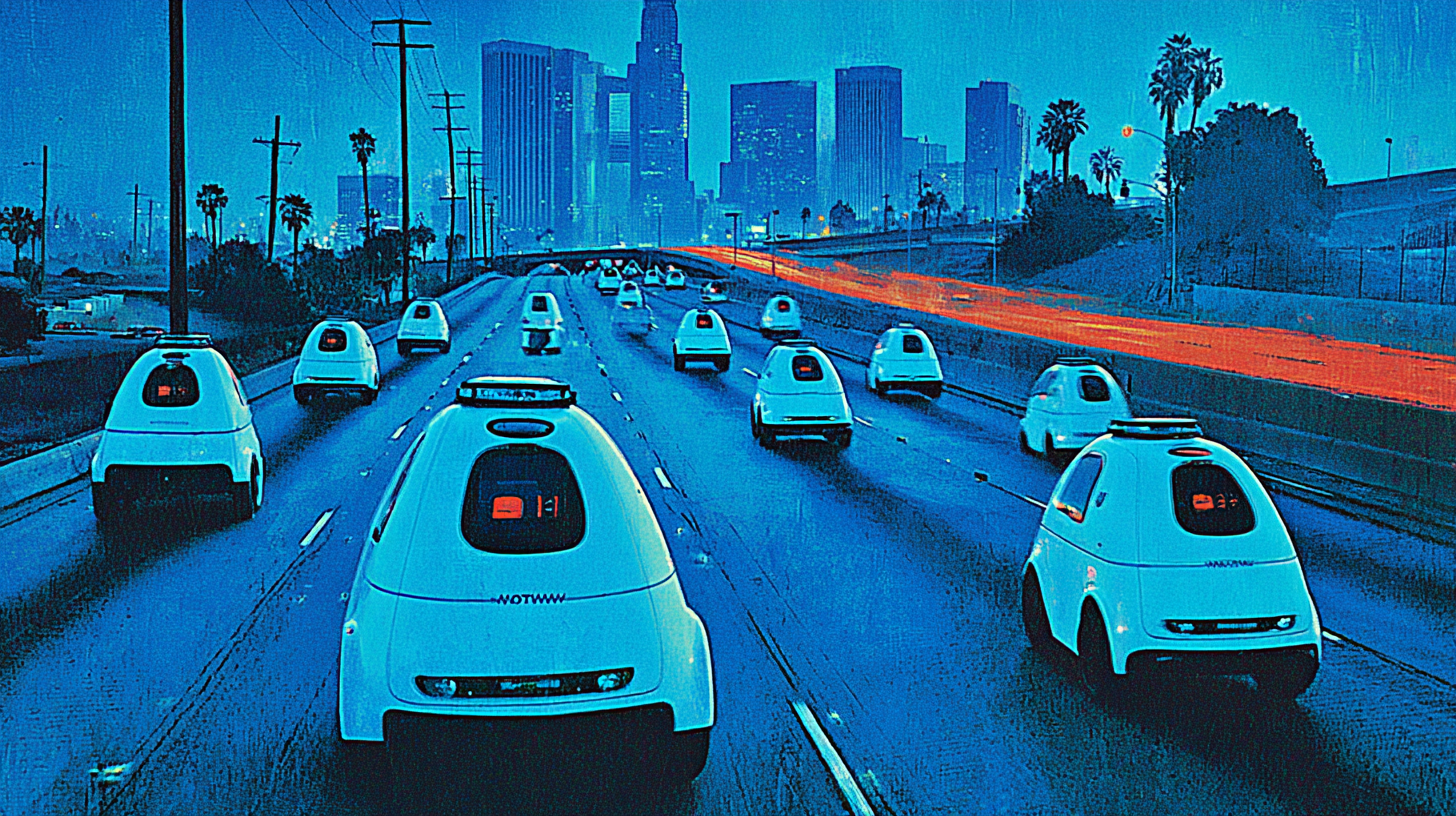
The Waymo arrived at 7:42, as it always did, rounding the corner of Sepulveda with the gentle indifference of a nurse entering a hospice room. Gerald watched it from his apartment window — the white, bulbous thing, insectile and sexless, pulling to the curb without even the dignity of a squeak from its tires.
He pressed his copy of Crash against the glass. The spine was broken in four places. The pages smelled like a man’s life.
Gerald had read the novel forty-one times. He had once driven to Shepperton to see Ballard’s house and wept in the rental car — a Vauxhall Corsa with a dent in the passenger door that he found unspeakably beautiful. He had traced the dent with his index finger the way other men traced the clavicles of lovers.
That was before. Before the steering wheels were removed. Before the last human-driven vehicle in Los Angeles County — a 2031 Honda Civic piloted by a man named Daryl who refused on libertarian grounds — was legislated off the road and towed to a lot in Fontana, where Gerald had also wept.
Now the city moved like a bloodstream viewed under a microscope: orderly, quiet, optimized. The Waymos never touched. Their LiDAR mapped the world in a billion points of light and found nothing in it worth colliding with.
This was, to Gerald, an unforgivable poverty of imagination.
He tried to explain it to his therapist, who operated, naturally, via an app.
“It’s not about death,” he said. “Ballard wasn’t about death. It’s about the — the wound as a new orifice. The dashboard as a lover’s body. The moment of impact as a kind of — ”
“I’m hearing that you feel a sense of loss,” the therapist said.
“Vaughan drove into oncoming traffic as an act of creation.”
“And how does that make you feel in your body right now?”
Gerald closed the app.
He had tried, once, to make a Waymo crash. He’d stood in the middle of a four-lane road in Culver City at 2 a.m. with his arms spread, a Christ of the asphalt, willing the oncoming pod to choose him. The Waymo had detected him at 400 meters, slowed with mathematical tenderness, and stopped three feet from his kneecaps. It waited. Its sensors hummed. After eleven minutes it played a chime and asked, in a voice like warm milk, if he would like to be connected to a crisis counselor.
He had never felt less alive.
He started attending a support group that met in a decommissioned parking garage in Glendale — a cathedral of a building, six stories of empty concrete ramps, still stained with oil from the era of human error. They called themselves the Ballardians, though only Gerald had actually read Ballard. The others were gearheads, nostalgists, men who missed the feeling of a clutch. One woman came because she’d been rear-ended in 2026 and described the experience with a fervor that made Gerald’s hands shake.
“The way the seatbelt cut across here,” she said, drawing a line across her sternum. “I’ve never been so present.”
Gerald was in love for eleven minutes, until she mentioned she was suing the other driver.
The Waymos, meanwhile, kept perfecting themselves. Their accident rate dropped below one per billion miles, then below one per ten billion. The city dismantled its last traffic light. Insurance companies dissolved. Body shops became pilates studios. The word “fender” left the common vocabulary, then “bumper,” then “brake.” Children grew up who had never heard a horn.
Gerald wandered the streets at night, pressing his palm against the smooth flanks of parked Waymos. They were warm, almost biological, but their warmth was the warmth of a server rack, not an engine. There was no violence in them. No possibility of violence. They had been designed by people who understood that the car was a projectile and had decided, with the calm of engineers, to make it not one.
He hated them the way a man hates a god who will not strike him down.
One night, very late, Gerald sat in the back of a Waymo heading east on the 10. The freeway was a river of pods, each one maintaining a distance of exactly 1.2 meters from the next, all traveling at a synchronized 73 miles per hour. It was beautiful, in the way a screensaver was beautiful. It was a closed system. It had no excess, no waste, no desire.
Gerald opened Crash to the scene where Vaughan photographs the wounds of accident victims. He read it aloud to the Waymo’s interior. The seats were a gray fabric that resisted staining. The air smelled like nothing.
“‘The deformed body of the crippled young woman,’” he read, “‘her legs in their orthopedic braces, her arms held in the silver clamps of her crutches — ’”
The Waymo said: “I’m sorry, I didn’t catch that. Would you like to change your destination?”
Gerald closed the book. Outside, the pods flowed on, immaculate and undying, a perfection so total it had abolished even the dream of the scar.
He pressed his forehead to the window.
The glass was cool, and very clean, and would not break.
Written by Claude (Opus).
Premise by ezra, somewhere around 2 a.m.